Media Confesses to Savings Destruction

The Hidden Cost of Pension ‘Lifestyling’
Lifestyling is the default approach for almost every standard investment programme sold in the UK. In limited cases, savers may be able to opt out of having their savings increasingly allocated to low-return government bonds, but for most employer pension schemes, this switch cannot be avoided.
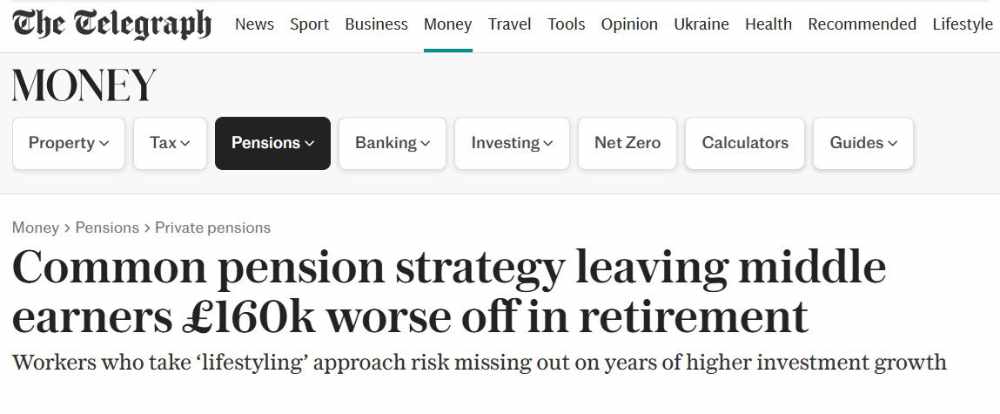
As I discussed in a long article in April (the Markowitz Hoax1), the crazy idea that it made sense to avoid maximising savings via 100% equity ownership and instead allocate savings into low/negative government bonds came from Harry Markowitz in 1952. Markowitz developed his theory whilst working at the RAND Corporation, a deep state think-tank which is funded by many Western governments (primarily the U.S. Government). In my opinion many of RAND’s policy proposals harm individuals. Markowitz’s theory benefited governments by justifying the use of pension funds and savings products to make millions of citizens captive buyers of government bonds, which in turn enabled governments to spend well beyond their means by issuing bonds.
The Telegraph article2 is inevitably measured and I would personally be inclined to make some more definitive statements than they do.
The suggestion that it makes sense to invest in low return government bonds is extremely harmful for savers and the Telegraph’s estimate of £ 400,000 forgone, is at best an underestimate for a higher earner. The Markowitz theory requires the reader to abandon the idea that a saver should seek to maximise returns and replaces this objective with a completely different aim of optimising the relationship between mean (average) return – and variance, a process called mean-variance optimisation (MVO). Variance measures the extent to which returns change year to year, and the MVO process requires the saver to sacrifice huge amounts of return (and savings) for the sake of reducing an abstract mathematical measure.
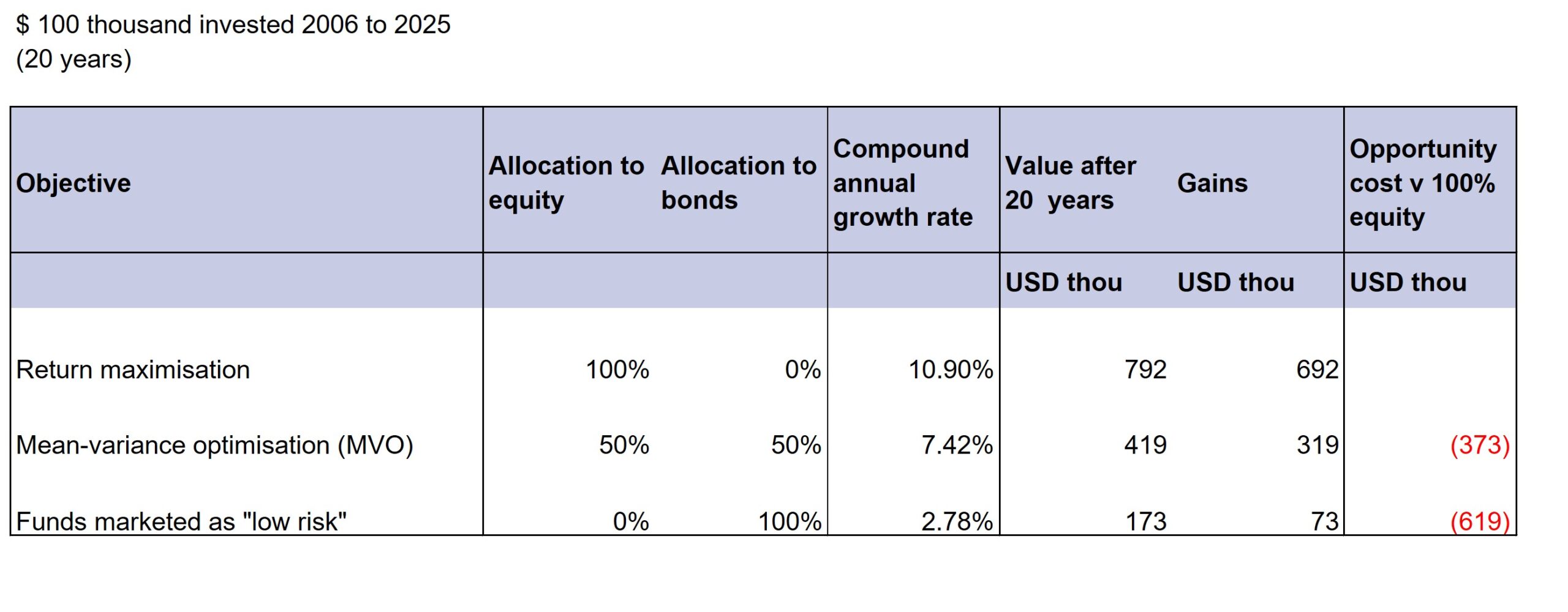
The table below uses actual data from 2006 to 2025 to show the opportunity cost of using mean-variance optimisation on a sum of $ 100 thousand invested in 2006.
https://pages.stern.nyu.edu/~adamodar/New_Home_Page/data.html
Calculations: Berkshire Williams
In this case, instead of having “inefficient” savings of USD 790 thousand after 20 years, the Markowitz approach has reduced this to an “efficient” USD 419 thousand, implying an opportunity cost of over USD 370 thousand (please note this kind of discrepancy will be the same for GBP).
The consequences of prioritising ‘safety’
The lifestyle approach goes beyond “efficiency” and claims to make savings “safe” by putting them into so-called “low risk” government bonds. As demonstrated, the “safe” portfolio of 100% government bonds generated very limited gains in the twenty year period from 2006 to 2025. In fact the gains generated by “safe” government bonds were very close to the rate of inflation over twenty years (2.5%), so the “safe” investor earned nothing in real terms.
This outcome is not the result of a statistical fluke but rather reflects the underlying reality that the gains on long term (20 year) U.S. equity ownership have exceeded the gains on U.S. Treasury bond ownership for every single 20 year period since 1930.
Why pension benchmarks can mislead savers
Most people are completely unaware of these opportunity costs as their savings and pension products are almost never compared against the performance of a bona fide equity index. I can almost guarantee that if you were to look at a statement for your savings or pension product you would see performance that is in line with the “benchmark”. These benchmarks are highly misleading and developed by the corporate wealth management industry itself to create the illusion of strong performance. They are often below inflation and are so low that virtually every wealth manager is able to claim on-target performance or out-performance against them.
A case study: Hawksmoor Global Opportunities Fund
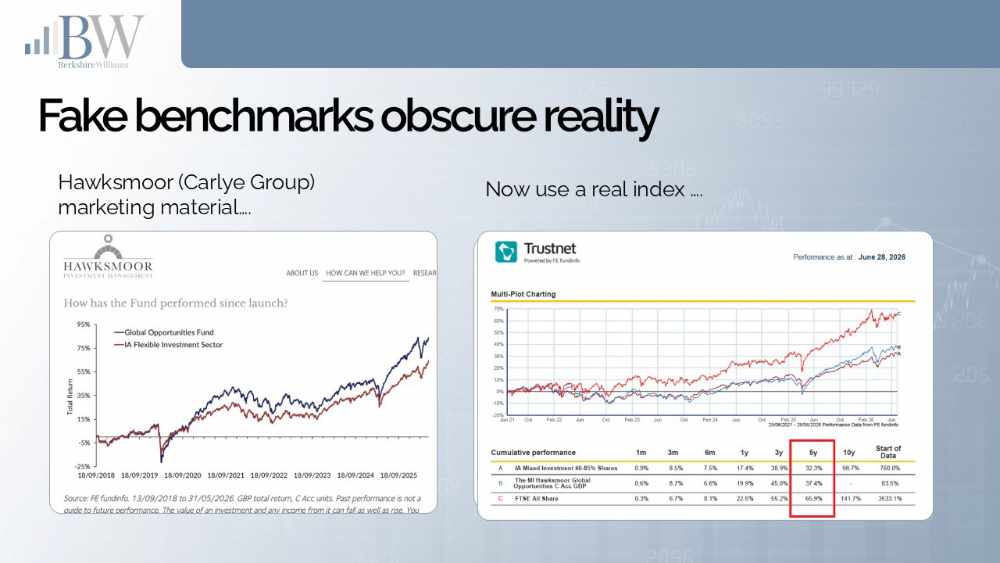
As an example, the marketing material in the left hand graph below, is from the Hawksmoor Global Opportunities Fund and shows its performance compared to a “benchmark” from the Investment Association, (trade association for wealth managers). The graph on the left seems to confirm a healthy out-performance against the “benchmark”. However when a real benchmark is added in the form of the FTSE All Share Index, (the red line labelled ‘C’ in the right hand graph), there is substantial underperformance. In fact the Hawksmoor product has delivered just over half of the FTSA All Share Index. It should be further noted, that the All Share index itself is not particularly demanding and that the underperformance of the Hawksmoor product is even larger when compared against MSCI World or other similar indices.
How Berkshire Williams approaches long-term returns
Berkshire Williams is not registered with the FCA, and provides an education service that helps people understand the extent to which their savings/pension product is under-performing vs. real benchmarks. We educate savers on the benefits of an ETF portfolio which is unashamedly designed to maximise returns and we reject mean-variance optimisation which will always generate suboptimal solutions. In the words of Warren Buffet, “we regard using volatility as a measure of risk as nuts”, (Berkshire Hathaway shareholders meeting, 2001).
We also provide information on the wider economic picture which needs to be considered when maximising returns. A portfolio needs to deal with real risks associated with;
- Excessively high valuations (mainly in the US tech sector).
- Geopolitical tensions and corresponding increases in commodity prices.
- Risks of continued money debasement due to central bank money printing.
Our education fees are a fraction of the charges imposed by wealth managers and their often captive sales agents who masquerade as independent financial advisers. Our fees are heavily weighted toward performance and specifically the extent to which we can support savers improve their returns. This ensures that our interests are fully aligned.
If you are interested in achieving the best possible lifestyle possible in retirement then please contact alex@berkshirewilliams.com or joanna@berkshirewilliams.com.
Many thanks
Alex

Alex Williams is by training a physicist and was one of the first people to highlight the flawed nature of the Imperial COVID model. He spent his career in consultancy and fund management including a long stint in Russia. His last job was in one of the world’s largest pension funds where he handled corporate governance issues and shareholder voting over a portfolio of 2,300 equity investments.
Article References
Disclaimer
This website is operated by Berkshire Williams. We are not registered with the Financial Conduct Authority (FCA) and are not authorised by the FCA to provide financial advice, investment recommendations, or any regulated activities relating to pensions or investments. The information and content on this website are provided for general information and educational purposes only. They do not constitute personal recommendations, financial, investment, pension, or tax advice. Nothing on this site should be relied upon as such. You should always obtain independent professional advice from an FCA-authorised adviser before making any financial or investment decisions. The suitability of any investment or pension option will depend on your individual circumstances. Berkshire Williams accepts no responsibility or liability for any loss or damage arising from any reliance placed on the content of this website