What You Need to Know about Pension Fees
Wealth management fees quietly erode retirement savings, and most investors pay far more than they need to for worse‑than‑market performance. High, layered charges from branded fund providers, commission‑driven sales practices, and fund managers who are paid regardless of results all combine to reduce returns and undermine the power of compounding, leaving many savers significantly worse off than if they simply used low‑cost index funds instead.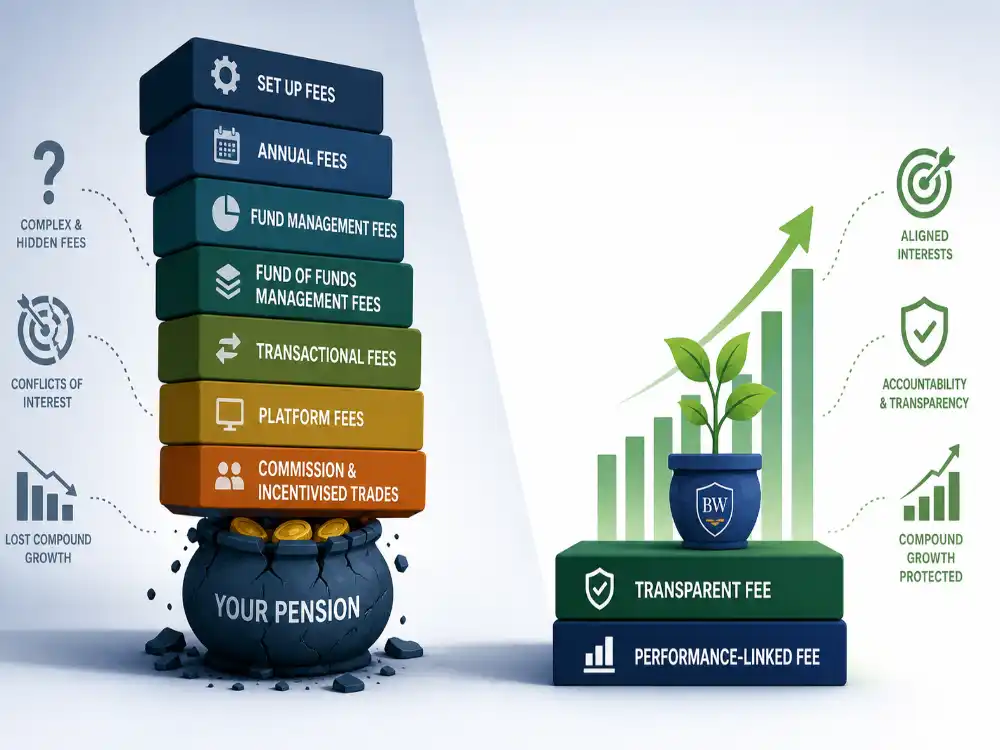
What is the problem with Pension Fees?
Problem 1: High Costs & Loss of Compound Benefits
There are a plethora of confusing asset management fees charged by fund managers that are not in any way justified by improved performance. Around 95% of actively managed funds underperform the S&P 500 index over a five year period, meaning that their costs are not covered by improved performance and that on balance investors receive below-market returns.
In the UK, the large companies that aggressively push and market branded funds often do not actually manage funds, this creates and entire layer of significant costs for the saver that generates absolutely no benefit. These marketing organisations pass the saver’s money on to another layer of management companies who charge a second set of fees to actually manage (more often mismanage) the saver’s funds. For the largest provider in the UK, the first level of costs are around 1% per annum with around an additional 0.5% for companies who actually manage (mismanage) the money giving a total of 1.5%. The equivalent cost for a simple passive exchange traded fund is around 0.1% or almost 94% lower than the active equivalent.
Problem 2: Commission & Incentivised Trades
The companies that brand investment products engage literal armies of salespeople either as captive financial advisers or independent financial advisers on commission. The model is fundamentally unworkable, since advisers are incentivised to sell the funds that generate the highest commissions, generally the most expensive funds which create the largest negative impact on savers returns. These arrangements are unsound and completely misalign the interests of the adviser and their clients. Captive advisers can only recommend the products of their sponsor, irrespective of the fact that other far better investment products are likely to be available. We are not a financial adviser and do not sell anybody’s products or receive any commissions from fund managers or anyone else.
3. Lack of Accountability & Performance-Related Pay
Fund managers extract annual fees irrespective of how well or badly they are performing. As discussed above around 95% of active fund managers underperform the S&P 500 index over a five year period, what this means is that 95% of savers would achieve better investment performance by not employing a high fee manager and instead themselves buying a low-cost index product in the form of an exchange traded fund.
Fund managers have developed a number of ruses to hide these terrible statistics. The most straight forward ruse is not to provide any benchmark at all, so it is impossible for a client to know if a 5% return is good or bad. A more devious ruse is to use fake benchmarks, the UK Investment Association works with data providers to create so called benchmarks which are generally far lower than true market index benchmarks. This allows funds to claim “out-performance” (using indices developed in cooperation with the Investment Association) whilst significantly under-performing the true benchmark indices. The most dangerous ruse of all though is increasing risks in the fund through the use of risky leverage and the inclusion of derivates but delivering only market level returns. The returns created by leverage are effectively consumed by the fund manager leaving the saver with risk but no commensurate reward.